
 Memora
Give your AI agents persistent memory
A lightweight MCP server for semantic memory storage, knowledge graphs, and cross-session context.



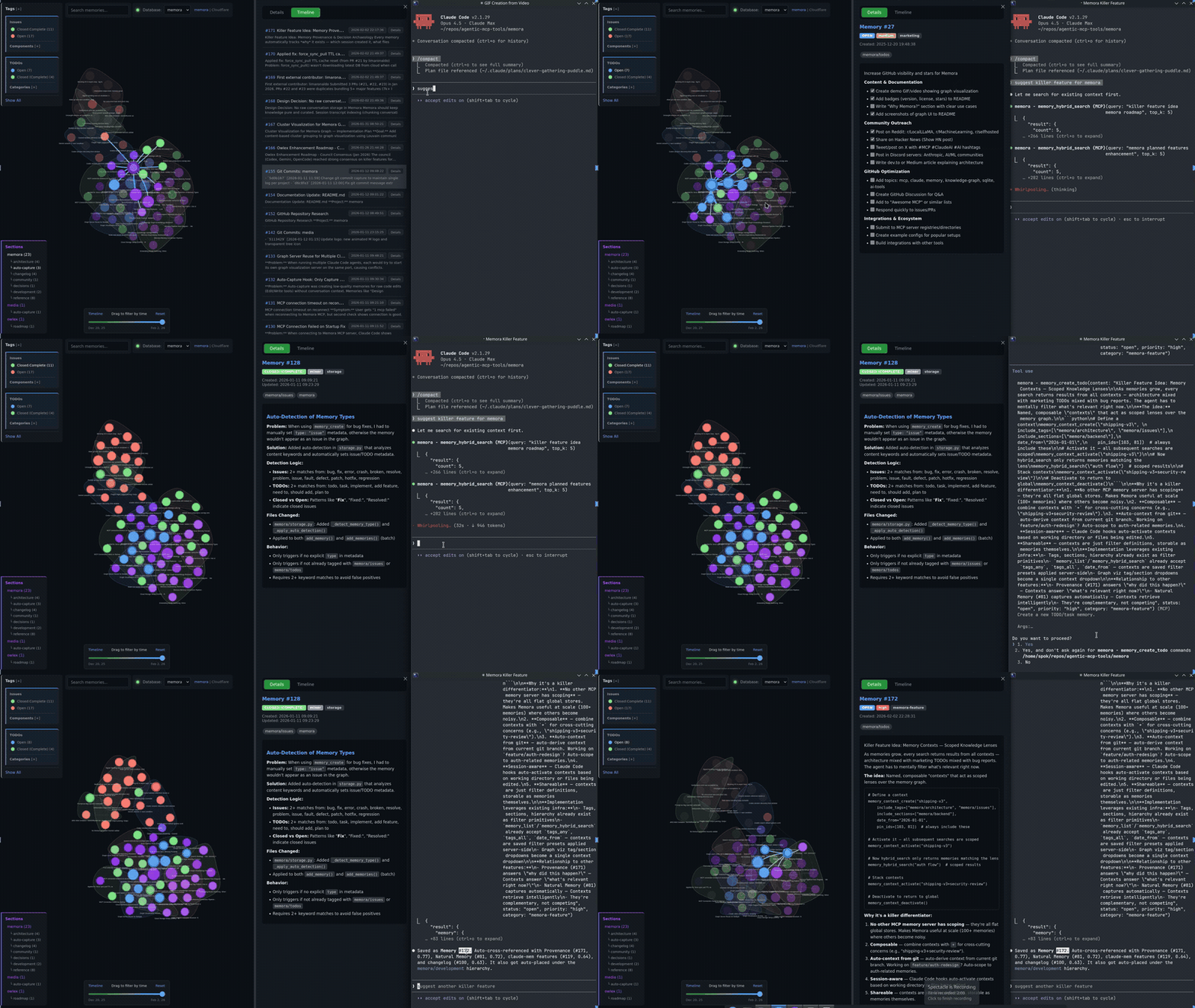
Features · Install · Usage · Config · Live Graph · Semantic Search · LLM Deduplication
Features
- 💾 Persistent Storage - SQLite-backed database with optional cloud sync (S3, GCS, Azure)
- 🔍 Semantic Search - Vector embeddings (TF-IDF, sentence-transformers, or OpenAI)
- 🤖 LLM Deduplication - Find and merge duplicate memories with AI-powered comparison
- ⚡ Memory Automation - Structured tools for TODOs, issues, and section placeholders
- 🔗 Memory Linking - Typed edges, importance boosting, and cluster detection
- 📡 Event Notifications - Poll-based system for inter-agent communication
- 🎯 Advanced Queries - Full-text search, date ranges, tag filters (AND/OR/NOT)
- 🔀 Cross-references - Auto-linked related memories based on similarity
- 📂 Hierarchical Organization - Explore memories by section/subsection
- 📦 Export/Import - Backup and restore with merge strategies
- 🕸️ Knowledge Graph - Interactive HTML visualization with Mermaid diagram rendering
- 🌐 Live Graph Server - Auto-starts HTTP server for remote access via SSH
- 📊 Statistics & Analytics - Tag usage, trends, and connection insights
Install
pip install git+https://github.com/agentic-mcp-tools/memora.git
Includes cloud storage (S3/R2) and OpenAI embeddings out of the box.
# Optional: local embeddings (offline, ~2GB for PyTorch)
pip install "memora[local]" @ git+https://github.com/agentic-mcp-tools/memora.git
Usage
The server runs automatically when configured in Claude Code. Manual invocation:
# Default (stdio mode for MCP)
memora-server

# With graph visualization server
memora-server --graph-port 8765

# HTTP transport (alternative to stdio)
memora-server --transport streamable-http --host 127.0.0.1 --port 8080
Configuration
Claude Code
Add to .mcp.json in your project root:
Local DB:
{
  "mcpServers": {
    "memora": {
      "command": "memora-server",
      "args": [],
      "env": {
        "MEMORA_DB_PATH": "~/.local/share/memora/memories.db",
        "MEMORA_ALLOW_ANY_TAG": "1",
        "MEMORA_GRAPH_PORT": "8765"
      }
    }
  }
}
Cloud DB (Cloudflare D1) - Recommended:
{
  "mcpServers": {
    "memora": {
      "command": "memora-server",
      "args": ["--no-graph"],
      "env": {
        "MEMORA_STORAGE_URI": "d1://<account-id>/<database-id>",
        "CLOUDFLARE_API_TOKEN": "<your-api-token>",
        "MEMORA_ALLOW_ANY_TAG": "1"
      }
    }
  }
}
With D1, use --no-graph to disable the local visualization server. Instead, use the hosted graph at your Cloudflare Pages URL (see Cloud Graph).
Cloud DB (S3/R2) - Sync mode:
{
  "mcpServers": {
    "memora": {
      "command": "memora-server",
      "args": [],
      "env": {
        "AWS_PROFILE": "memora",
        "AWS_ENDPOINT_URL": "https://<account-id>.r2.cloudflarestorage.com",
        "MEMORA_STORAGE_URI": "s3://memories/memories.db",
        "MEMORA_CLOUD_ENCRYPT": "true",
        "MEMORA_ALLOW_ANY_TAG": "1",
        "MEMORA_GRAPH_PORT": "8765"
      }
    }
  }
}
Codex CLI
Add to ~/.codex/config.toml:
[mcp_servers.memora]
  command = "memora-server"  # or full path: /path/to/bin/memora-server
  args = ["--no-graph"]
  env = {
    AWS_PROFILE = "memora",
    AWS_ENDPOINT_URL = "https://<account-id>.r2.cloudflarestorage.com",
    MEMORA_STORAGE_URI = "s3://memories/memories.db",
    MEMORA_CLOUD_ENCRYPT = "true",
    MEMORA_ALLOW_ANY_TAG = "1",
  }
Environment Variables
| Variable | Description |
|---|---|
MEMORA_DB_PATH | Local SQLite database path (default: ~/.local/share/memora/memories.db) |
MEMORA_STORAGE_URI | Storage URI: d1://<account>/<db-id> (D1) or s3://bucket/memories.db (S3/R2) |
CLOUDFLARE_API_TOKEN | API token for D1 database access (required for d1:// URI) |
MEMORA_CLOUD_ENCRYPT | Encrypt database before uploading to cloud (true/false) |
MEMORA_CLOUD_COMPRESS | Compress database before uploading to cloud (true/false) |
MEMORA_CACHE_DIR | Local cache directory for cloud-synced database |
MEMORA_ALLOW_ANY_TAG | Allow any tag without validation against allowlist (1 to enable) |
MEMORA_TAG_FILE | Path to file containing allowed tags (one per line) |
MEMORA_TAGS | Comma-separated list of allowed tags |
MEMORA_GRAPH_PORT | Port for the knowledge graph visualization server (default: 8765) |
MEMORA_EMBEDDING_MODEL | Embedding backend: tfidf (default), sentence-transformers, or openai |
SENTENCE_TRANSFORMERS_MODEL | Model for sentence-transformers (default: all-MiniLM-L6-v2) |
OPENAI_API_KEY | API key for OpenAI embeddings and LLM deduplication |
OPENAI_BASE_URL | Base URL for OpenAI-compatible APIs (OpenRouter, Azure, etc.) |
OPENAI_EMBEDDING_MODEL | OpenAI embedding model (default: text-embedding-3-small) |
MEMORA_LLM_ENABLED | Enable LLM-powered deduplication comparison (true/false, default: true) |
MEMORA_LLM_MODEL | Model for deduplication comparison (default: gpt-4o-mini) |
AWS_PROFILE | AWS credentials profile from ~/.aws/credentials (useful for R2) |
AWS_ENDPOINT_URL | S3-compatible endpoint for R2/MinIO |
R2_PUBLIC_DOMAIN | Public domain for R2 image URLs |
Semantic Search & Embeddings
Memora supports three embedding backends:
| Backend | Install | Quality | Speed |
|---|---|---|---|
openai (default) | Included | High quality | API latency |
sentence-transformers | pip install memora[local] | Good, runs offline | Medium |
tfidf | Included | Basic keyword matching | Fast |
Automatic: Embeddings and cross-references are computed automatically when you memory_create, memory_update, or memory_create_batch.
Manual rebuild required when:
- Changing
MEMORA_EMBEDDING_MODELafter memories exist - Switching to a different sentence-transformers model
# After changing embedding model, rebuild all embeddings
memory_rebuild_embeddings

# Then rebuild cross-references to update the knowledge graph
memory_rebuild_crossrefs
Live Graph Server
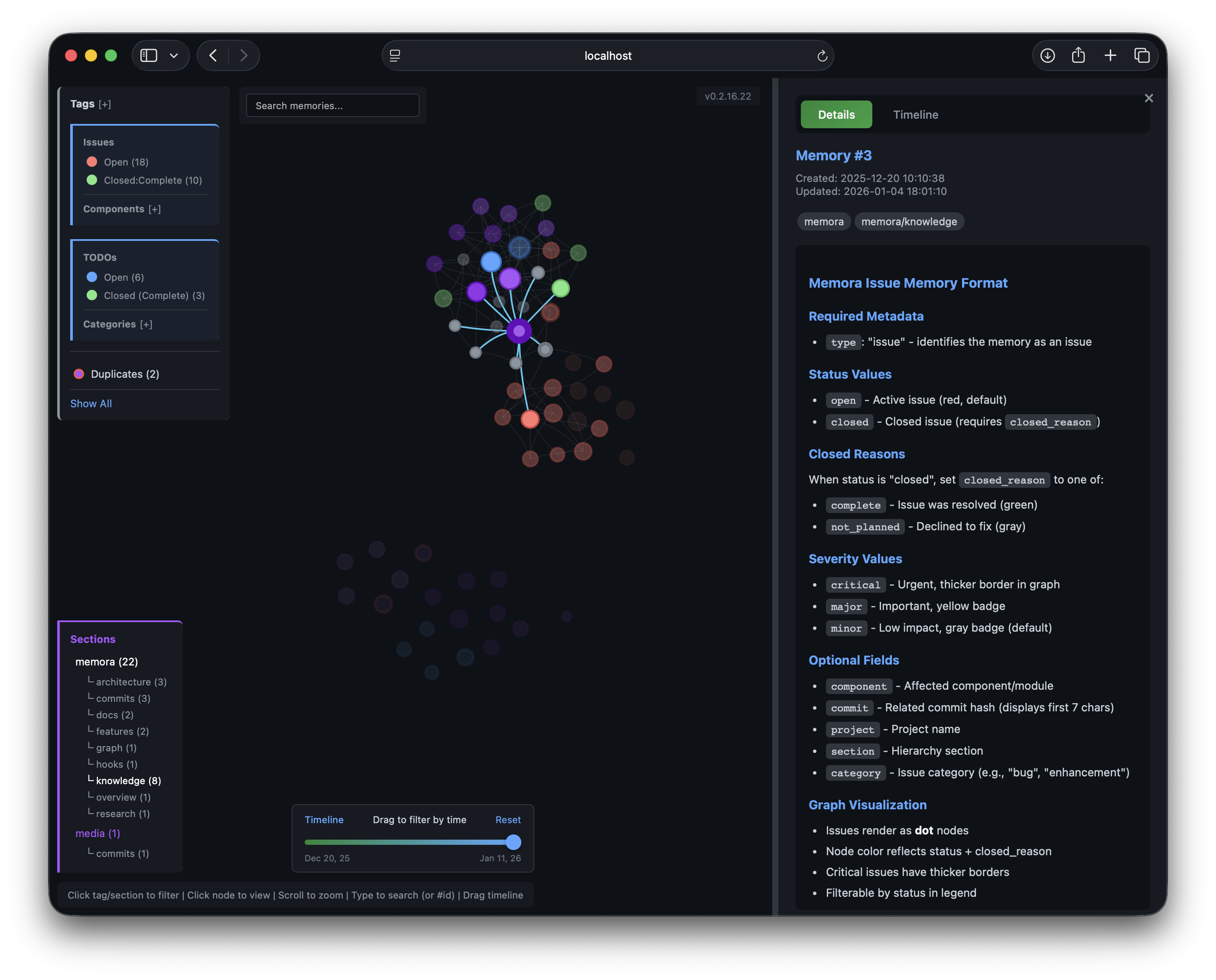
A built-in HTTP server starts automatically with the MCP server, serving an interactive knowledge graph visualization.
 Details Panel | 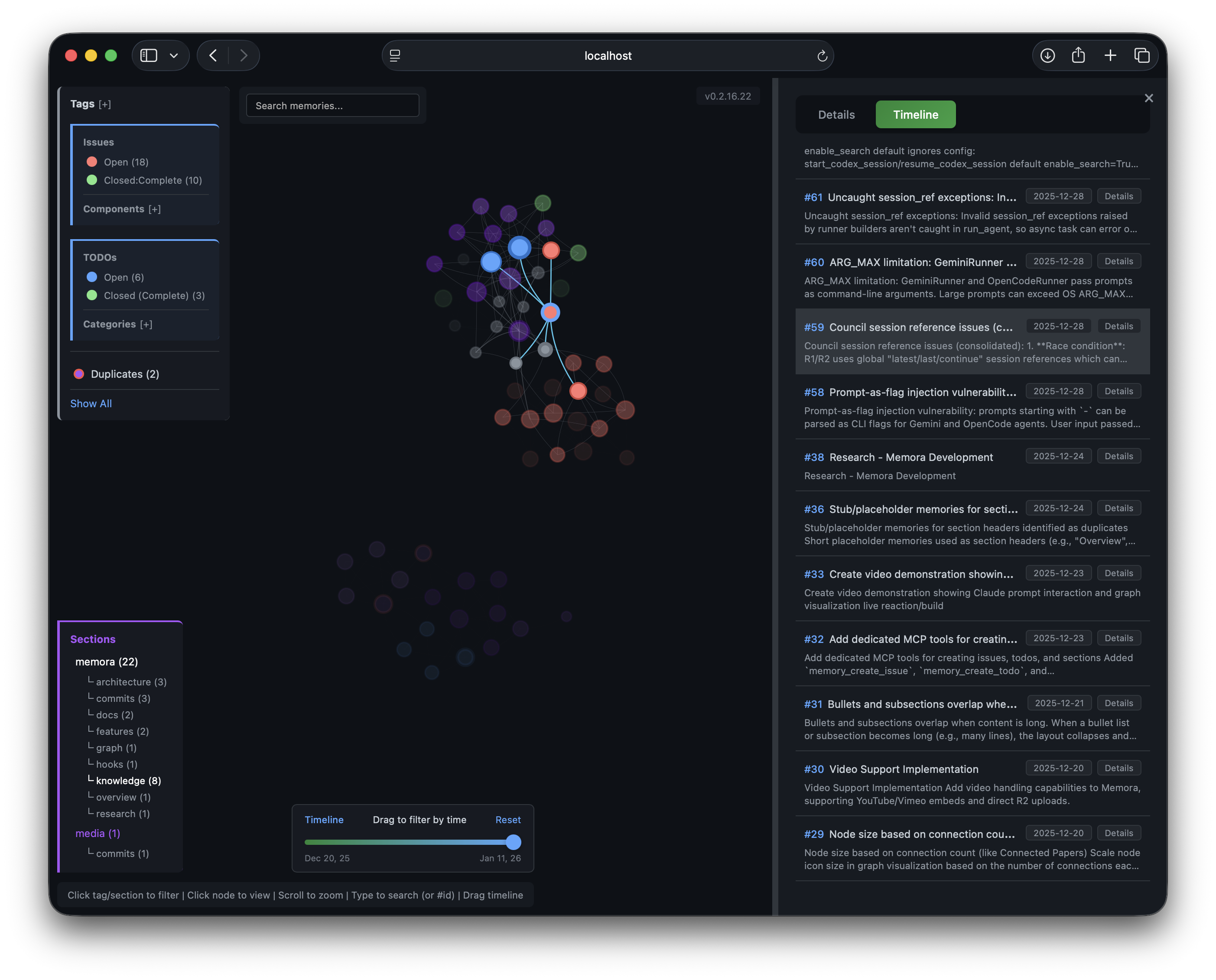 Timeline Panel |
Access locally:
http://localhost:8765/graph
Remote access via SSH:
ssh -L 8765:localhost:8765 user@remote
# Then open http://localhost:8765/graph in your browser
Configuration:
{
  "env": {
    "MEMORA_GRAPH_PORT": "8765"
  }
}
To disable: add "--no-graph" to args in your MCP config.
Graph UI Features
- Details Panel - View memory content, metadata, tags, and related memories
- Timeline Panel - Browse memories chronologically, click to highlight in graph
- Time Slider - Filter memories by date range, drag to explore history
- Real-time Updates - Graph and timeline update via SSE when memories change
- Filters - Tag/section dropdowns, zoom controls
- Mermaid Rendering - Code blocks render as diagrams
Node Colors
- 🟣 Tags - Purple shades by tag
- 🔴 Issues - Red (open), Orange (in progress), Green (resolved), Gray (won't fix)
- 🔵 TODOs - Blue (open), Orange (in progress), Green (completed), Red (blocked)
Node size reflects connection count.
Neovim Integration
Browse memories directly in Neovim with Telescope. Copy the plugin to your config:
# For kickstart.nvim / lazy.nvim
cp nvim/memora.lua ~/.config/nvim/lua/kickstart/plugins/
Usage: Press <leader>sm to open the memory browser with fuzzy search and preview.
Requires: telescope.nvim, plenary.nvim, and memora installed in your Python environment.
Knowledge Graph Export (Optional)
For offline viewing, export memories as a static HTML file:
memory_export_graph(output_path="~/memories_graph.html", min_score=0.25)
This is optional - the Live Graph Server provides the same visualization with real-time updates.
Cloud Graph (Recommended for D1)
When using Cloudflare D1 as your database, the graph visualization is hosted on Cloudflare Pages - no local server needed.
Benefits:
- Access from anywhere (no SSH tunneling)
- Real-time updates via WebSocket
- Multi-database support via
?db=parameter - Secure access with Cloudflare Zero Trust
Setup:
-
Create D1 database:
npx wrangler d1 create memora-graph npx wrangler d1 execute memora-graph --file=memora-graph/schema.sql -
Deploy Pages:
cd memora-graph npx wrangler pages deploy ./public --project-name=memora-graph -
Configure bindings in Cloudflare Dashboard:
- Pages → memora-graph → Settings → Bindings
- Add D1:
DB_MEMORA→ your database - Add R2:
R2_MEMORA→ your bucket (for images)
-
Configure MCP with D1 URI:
{
  "env": {
    "MEMORA_STORAGE_URI": "d1://<account-id>/<database-id>",
    "CLOUDFLARE_API_TOKEN": "<your-token>"
  }
}
Access: https://memora-graph.pages.dev
Secure with Zero Trust:
- Cloudflare Dashboard → Zero Trust → Access → Applications
- Add application for
memora-graph.pages.dev - Create policy with allowed emails
- Pages → Settings → Enable Access Policy
See memora-graph/ for detailed setup and multi-database configuration.
LLM Deduplication
Find and merge duplicate memories using AI-powered semantic comparison:
# Find potential duplicates (uses cross-refs + optional LLM analysis)
memory_find_duplicates(min_similarity=0.7, max_similarity=0.95, limit=10, use_llm=True)

# Merge duplicates (append, prepend, or replace strategies)
memory_merge(source_id=123, target_id=456, merge_strategy="append")
LLM Comparison analyzes memory pairs and returns:
verdict: "duplicate", "similar", or "different"confidence: 0.0-1.0 scorereasoning: Brief explanationsuggested_action: "merge", "keep_both", or "review"
Works with any OpenAI-compatible API (OpenAI, OpenRouter, Azure, etc.) via OPENAI_BASE_URL.
Memory Automation Tools
Structured tools for common memory types:
# Create a TODO with status and priority
memory_create_todo(content="Implement feature X", status="open", priority="high", category="backend")

# Create an issue with severity
memory_create_issue(content="Bug in login flow", status="open", severity="major", component="auth")

# Create a section placeholder (hidden from graph)
memory_create_section(content="Architecture", section="docs", subsection="api")
Memory Linking
Manage relationships between memories:
# Create typed edges between memories
memory_link(from_id=1, to_id=2, edge_type="implements", bidirectional=True)

# Edge types: references, implements, supersedes, extends, contradicts, related_to

# Remove links
memory_unlink(from_id=1, to_id=2)

# Boost memory importance for ranking
memory_boost(memory_id=42, boost_amount=0.5)

# Detect clusters of related memories
memory_clusters(min_cluster_size=2, min_score=0.3)