
FPL MCP Server
A Model Context Protocol (MCP) server for the Fantasy Premier League API.
Installation
Install from NPM (Recommended)
npm install -g fpl-mcp
Install from Source
git clone https://github.com/owen-lacey/fpl-mcp.git
cd fpl-mcp
npm install
npm run build
Quick Start
Using with Claude Desktop
If installed via NPM, add this to your claude_desktop_config.json:
{
  "mcpServers": {
    "fpl-api": {
      "command": "npx",
      "args": ["fpl-mcp@latest"]
    }
  }
}
If installed from source, use:
{
  "mcpServers": {
    "fpl-api": {
      "command": "node",
      "args": ["/path/to/fpl-mcp/build/src/server.js"]
    }
  }
}
Inspect the MCP tools
Use the Model Inspector to explore available tools:
npx @modelcontextprotocol/inspector npx fpl-mcp
Usage Example
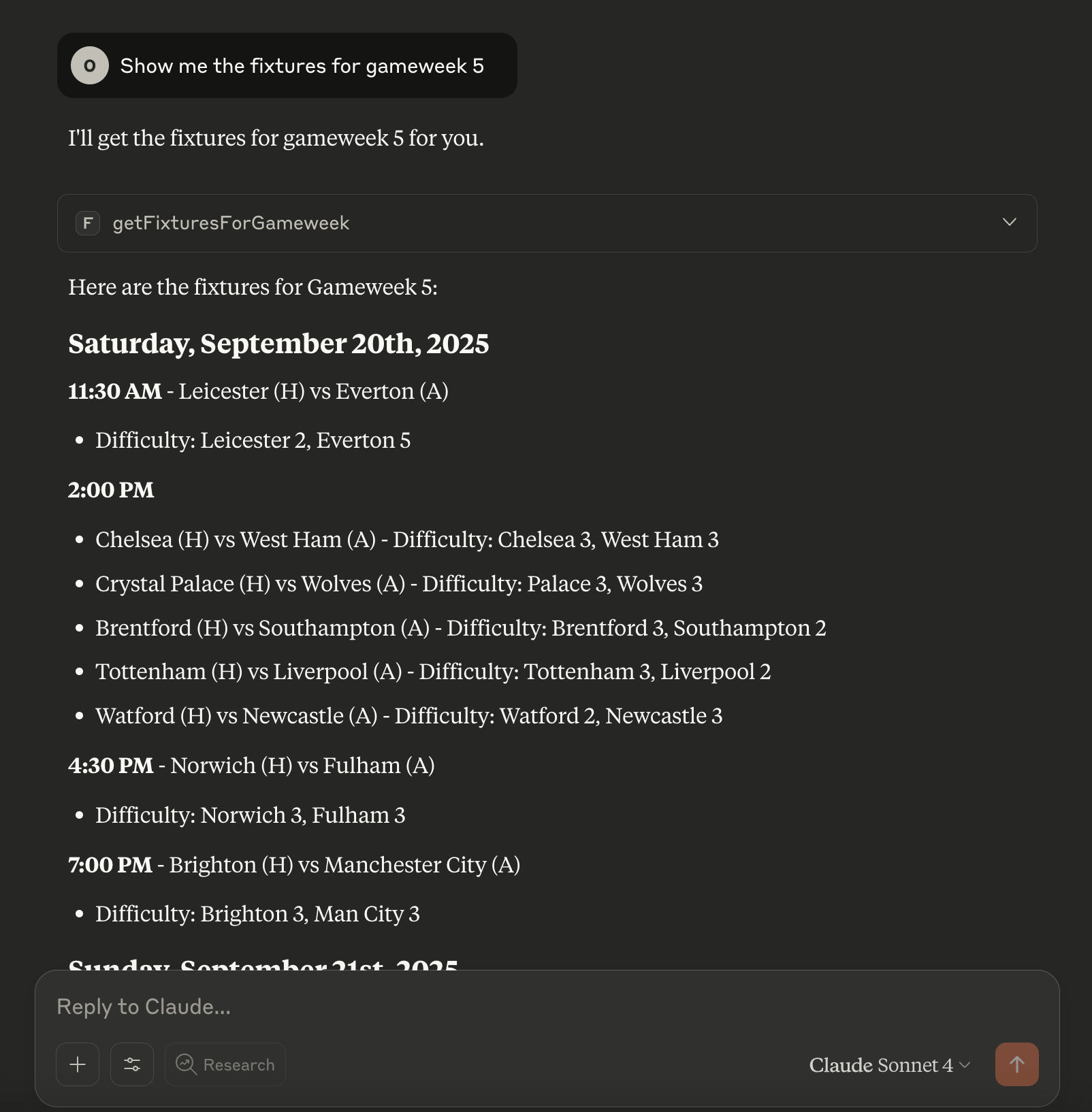
You can connect this MCP server to Claude Desktop and interact with FPL data using natural language.
Endpoints Supported
See docs/fpl-api-cheatsheet.md for all FPL API endpoints exposed as MCP tools.
Example Prompts
Use these prompts to interact with the MCP server via your LLM:
- "Show me the fixtures for gameweek 5."
- "How am I doing in my private leagues (team id is 12345)?"
- "How did mo salah get on in GW1?"
You can ask natural language questions about any supported endpoint. The LLM will use the appropriate MCP tool to fetch the data.
Development
Publishing to npm
This repository includes a GitHub Actions workflow that automatically publishes to npm when the version number in package.json changes.
Setup
-
Create an npm access token:
- Log in to npmjs.com
- Go to Access Tokens in your account settings
- Generate a new "Automation" token
-
Add the token to GitHub Secrets:
- Go to your repository Settings > Secrets and variables > Actions
- Create a new secret named
NPM_TOKEN - Paste your npm token as the value
-
Publish a new version:
- Update the version in
package.json(e.g.,1.0.1→1.0.2) - Commit and push to the
mainbranch - The workflow will automatically build and publish to npm
- A git tag (e.g.,
v1.0.2) will be created automatically
- Update the version in
License
MIT